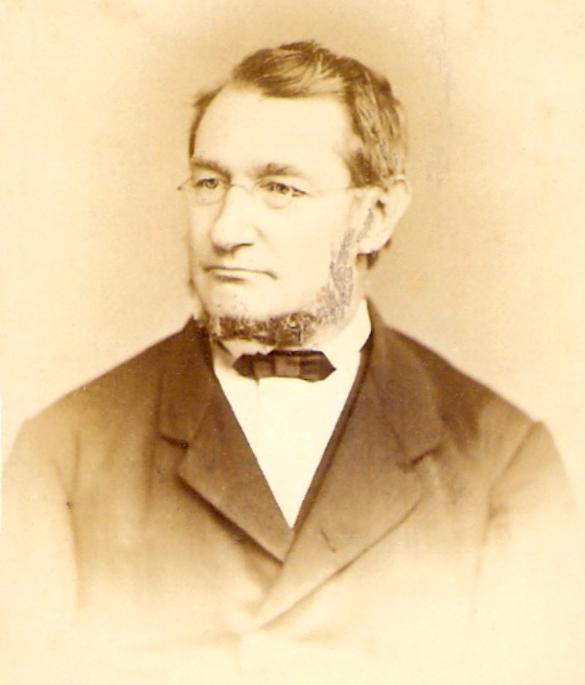
Julius Robert von Mayer
One of the first to formulate the principle of conservation of energy (first law of thermodynamics) - that energy (work, heat) is conserved - and early attempt to quantify the mechanical equivalent of heat.
Julius Robert von Mayer (1814-1878) was a German physician and physicist whose 1842 work laid down one of the earliest clear statements of energy conservation - the idea that energy cannot be created or destroyed, only transformed.
Julius Robert von Mayer was born on 25 November 1814 in Heilbronn, Kingdom of Württemberg. He studied medicine - enrolling at the University of Tübingen, and later worked as a physician. In 1840 Mayer embarked as a ship's surgeon on a Dutch vessel bound for Java (East Indies). During this voyage, he observed that the venous blood of sailors in tropical climates appeared much redder than usual - leading him to reflect on the relationship between heat, metabolism, and chemical processes in living organisms. This insight contributed to his thinking about heat and energy conservation. After returning to Heilbronn, in 1842 Mayer published a paper "Bemerkungen über die Kräfte der unbelebten Natur" ("Remarks on the Forces of Inanimate Nature") in which he articulated a general law that what we now call conservation of energy: proposing that mechanical work and heat are interconvertible, and that total energy remains constant. He attempted a quantitative evaluation of the mechanical equivalent of heat - though his numerical result was inaccurate by modern standards, the conceptual leap was pivotal. Mayer continued to work in medicine in Heilbronn while refining his ideas; his writings were initially largely ignored due to poor presentation and lack of institutional connections. Late recognition began to come: in later years some scientists acknowledged his priority in formulating energy conservation. Mayer died on 20 March 1878 in Heilbronn. Although during his lifetime his ideas were underappreciated, today Julius Robert von Mayer is regarded as one of the founding fathers of thermodynamics and a pioneer in understanding the fundamental nature of energy transformation and conservation - ideas that now underpin all of modern physics and engineering.
Sources
- 1.Britannica - "Julius Robert von Mayer" biography. Encyclopedia Britannica
- 2.1911 Encyclopædia Britannica (via Wikisource) - on Mayer's life, publications and priority regarding conservation of energy. en.wikisource.org
- 3.UWaterloo / engineering history page on "Julius Robert Mayer" summarizing his contributions and dates. mhtlab.uwaterloo.ca
- 4.Encyclopedia.com - article on Mayer, his 1842 paper, and later recognition. encyclopedia.com
- 5.Physics Today / AIP - note on his initial neglect and later recognition. PHYSICS TODAY